Dispensary SEO: The complete cannabis search engine optimization guide

Dispensary Search Engine Optimization (SEO) is the combination of all the efforts you make to boost the ranking of your dispensary website in search engine results pages (SERPs), and increasingly, in AI-generated answers. This includes traditional search engines such as Google and Bing, plus AI search tools like Google AI Overviews, ChatGPT, and Perplexity. Google is still your first priority, since it drives the large majority of dispensary search traffic.
Great SEO rank for your cannabis business or dispensary creates awareness about your locations, products, and offerings. And, most importantly, makes it easier for customers to find you.
Where is your dispensary in the search engine results page?
The most important question you should think through is, “how do people find me?”
Start by using Google, Google Maps, and even AI assistants like ChatGPT. This is where most people will start when they are looking for a dispensary or product. Search for your business name and your competition.
Below are some example Google searches to find cannabis dispensaries near you.
Example Google searches for your dispensary
This isn’t a complete list of possible Google searches, but good examples of where to start, mixing location based, product based, and intent based searches.
- Dispensary [city name]
- Medical cannabis dispensary
- Dispensary near me
- Medical marijuana dispensary
- Name of dispensary
- Recreational marijuana dispensary [city name]
- Weed delivery [city name]
- THC gummies for sleep near me
Review the results shown on Search Engine Results Page (SERP)
The results of your search, such as “cannabis dispensary near me”, is shown on the Search Engine Results Page (SERP). Where your dispensary shows up in the SERP directly impacts your customers’ ability to find you. Increasingly, Google may also show an AI Overview above the traditional results, summarizing an answer before a searcher ever scrolls down to the local map pack or organic listings.
Target the first page of the search results
The ideal position is the first result on the first SERP, or a spot inside the local 3-pack map results.
Being cited inside an AI Overview matters just as much today. A growing share of searches never generate a click past the AI generated summary, so structuring your content so it can be quoted accurately (short, direct answers near the top of a section) has become part of ranking for the first page.
For example, a search for “DailyStory” shows a pay-per-click (PPC) ad first and then the organic search results:
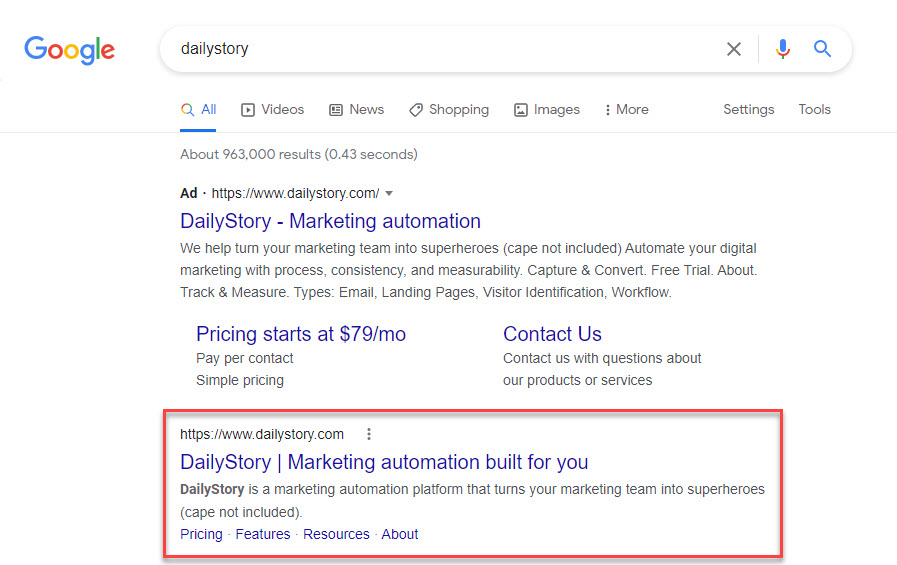
The “dailystory” keyword on the search engine results page returns the expected result: DailyStory | Marketing automation built for you on the first page of the first result on the SERP.
Rank for your organic keywords
Ranking is where your results show on the search engine result page for your dispensary keywords. Your goal is to “rank” on the first page for your most important keywords, such as your dispensary’s name.
For example, if your unique dispensary name isn’t first, that’s a problem, and you can’t run paid search on Google to fix it. Trying to rank for “marijuana dispensary” by itself will also be very difficult given the competition.
If your unique dispensary name is not showing up on the first page, you need to spend some time on your website’s search engine optimization and your Google Business Profile (formerly called Google My Business).
Unfortunately most dispensary owners don’t understand the power of Search Engine Optimization (SEO) or the value of a well managed Google Business Profile. But good SEO is one of the pillars of a great cannabis dispensary digital marketing strategy, and it’s worth the time and money.
Good SEO increases the amount of free traffic you generate to your website.
Below are some tips and recommendations. For a more comprehensive foundation, see our guide on 10 tips to improve organic search performance, or Google’s own SEO Starter Guide.
Optimize your dispensary website for search
Search engine optimization is everything you do on your website to optimize how search engines rank your content. And, while there are lots of tricks for squeezing the last bit of Google SEO juice out of a page such as republishing old articles, you should focus on the SEO fundamentals first.
Focusing on the SEO fundamentals starts with defining an organic search keyword list.
Define an organic search keyword list
An organic search keyword list is a list of words and phrases people use when they search for your dispensary.
Paid search, or pay-per-click (PPC), is paying the search engine to show ads when people search for those keywords or phrases. Dispensaries, cannabis, and CBD products have very limited options for using PPC, since Google and Meta both restrict cannabis advertising. We recommend focusing your efforts on organic search first.
To begin with, list the keywords that people will use when searching for your products and services. Write out a list in Google Sheets or Excel, since you’ll want to keep track of it.
Example dispensary SEO keywords
Good dispensary keywords tend to stack three layers: your brand and location, your products, and the customer’s intent. Examples include:
- Your dispensary name
- Dispensary + [city]
- Dispensary + [neighborhood]
- Recreational cannabis
- Product brands and specific strain names
- Where can I find flower near me
- Where to buy cannabis near me
- Product plus effect combinations, such as edibles for sleep or THC for anxiety
- and variations using Kush, marijuana, and vape
These are all common keywords and phrases potential customers might use. And they will likely use variations related to your location. So be creative when thinking through your keywords!
Optimize for long-tail keywords for visitor intent
Optimizing your dispensary website for long-tail keywords is a good strategy to align content with search intent.
What is a long-tail keyword? A long-tail keyword is a very specific phrase vs. an individual keyword. For example, “edible” is an example of a keyword. “Buy sativa edibles in Boulder Colorado” is an example of a long-tail keyword.
A long-tail keyword will not have the same search volume as a specific keyword, but it carries a much clearer intent. For dispensaries, long-tail, high-intent keywords such as “dispensary open late near me” often convert better than broad terms, since organic search is typically the only scalable acquisition channel available given the advertising restrictions on Google Ads and Meta.
Tools for tracking dispensary keywords and rank
We recommend using commercial tools to help with your SEO. We like SEMRush, but you may also want to look at Moz and Ahrefs. These tools can help you analyze your website and competitor’s dispensary websites for keywords and their ranking in SERPs. And, you use them to monitor your keywords and your ranking in the SERPs.
An alternative to the commercial tools, is Google’s Keyword Planner.
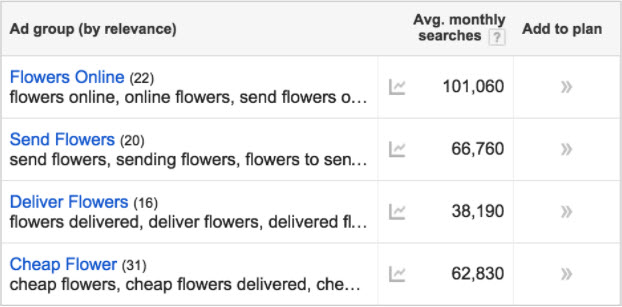
Google’s Keyword Planner is part of Google Ads. Keyword Planner was built to help you pick the right keywords for paid search (PPC). But you can also use it to identify keywords for your organic search too.
Google Keyword Planner will tell you the average monthly searches for a given keyword as well as provide related keywords:
Now that you’ve identified the best keywords used to help people find your dispensary, it’s time to use those keywords and phrases throughout your website.
Write great content using your dispensary short and long-tail keywords
“Content is King” and the Internet was built to help people easily access the content they need, such as finding your dispensary!
This means that in addition to basic content about your store and location, you should write content for your website that incorporates the keywords you want people to search for.
One of the easiest ways to do this is using a blog.
Start a blog focused on cannabis or CBD topics
Writing blog posts optimized for organic search is part of a content marketing strategy. Content marketing is beyond the scope of this article, but you can read more in our guide on leveling up your content marketing. Here we’ll cover some basics.
People love helpful content. Some examples you can use as a cannabis marketer:
- Share your knowledge and passion for the cannabis industry
- Talk about new strains and terpene profiles
- Provide product education around medical marijuana use, without making unverified medical claims
- Review different cannabis or CBD products
- Create a 4/20 guide for your city
- Write local, purchase ready content, such as delivery area guides or a best pre-rolls in [neighborhood] roundup
- Answer common questions, such as: what are the benefits of different strains?
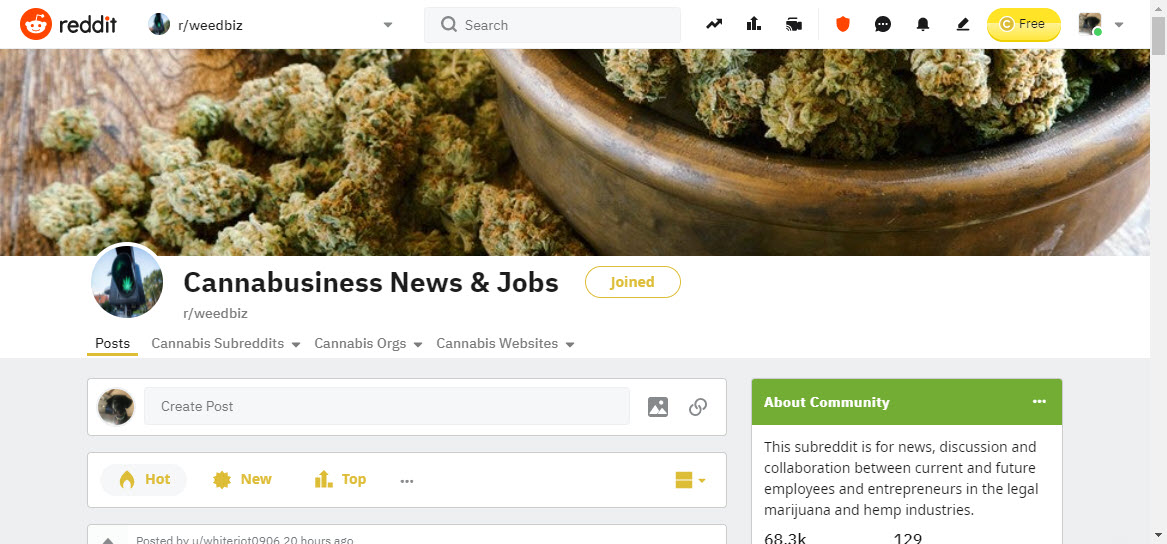
To get more ideas go to Quora or Reddit and search for cannabis related discussions. As an example, the r/weedbiz Subreddit is a great resource.
Write naturally, then reinforce with keyword variation
Older SEO advice focused on repeating an exact keyword phrase a set number of times per page. That approach can now hurt you. Google’s ranking systems, and the large language models powering AI Overviews and answer engines, reward comprehensive, naturally written content over exact match repetition, and can penalize obvious keyword stuffing.
Instead, write for the person reading the page first. Use your primary keyword once or twice where it reads naturally, then use related terms and synonyms (sometimes called semantic or LSI keywords) throughout the rest of the content. For example, a page about edibles can also naturally reference gummies, chocolates, dosing, and onset time.
Always include your important keyword or topic in the first paragraph. Location of the keyword or phrase still helps the search engine, and the reader, understand what the content is about. For more tactics, see our guides on 13 on-page SEO tips you can use today and the difference between on-page and off-page SEO.
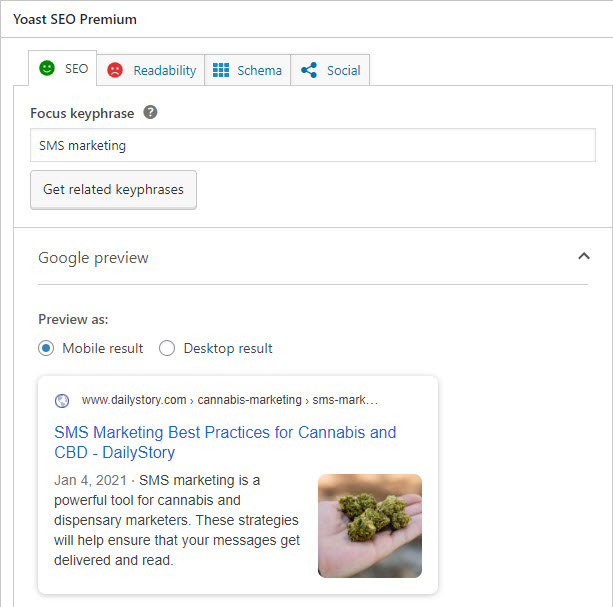
If you use WordPress for your website, consider using Yoast. There is a limited free version too. It’s an inexpensive plugin for WordPress that can help you author content focused on your keywords.
Use Standard HTML
When Google indexes your content it is looking through the web page examining the HTML markup to understand what the page is about.
It’s important to keep your content as simple as possible using standard HTML tags. Most important are header tags (h1, h2, h3, etc.).
Use dispensary SEO keywords in your section headers
Keywords should be included in the header tags to help Google and other search engines understand what the content is about.
For example, a bad header:
“We like this brand’s flower”
Versus a good SEO header:
“Ajoya Blue Dream is our favorite flower”
Each header should be no more than 70 to 90 characters.
Optimize page titles for dispensary SEO
Google considers the title HTML tag of your page to be another important SEO element of your page.
A great page title should be descriptive, concise, and include several of the keywords targeted for the article. The closer the keywords are to the beginning of the title, the better. Keep titles under about 60 characters so they are not truncated in the search results, and make sure the title still reads naturally, since Google frequently rewrites titles that look keyword stuffed.
Include your SEO keywords in the URL
Using keywords in your URL is important. The closer the keywords are to the domain, the better. For example, the URL for this article (excluding the domain):
/cannabis-marketing/dispensary-search-engine-optimization-guide
In this case /cannabis-marketing is a category of content. And the article is /dispensary-search-engine-optimization-guide.
Make sure you remove SEO stop words from your URL too.
Include dispensary keywords in the URL
The keywords for this article include “cannabis marketing”, “digital marketing”, “dispensary”, “dispensary owners” and more. So you can see how the URL includes important keywords related to the article.
The goal with your URL is again to help search engines understand what the content is about. Also, use hyphens to separate words.
Design for mobile to boost dispensary SEO
Cannabis marketers love SMS marketing. SMS marketing has a 95% open rate, because people are always on their mobile devices.
Google evaluates the mobile version of your website as the primary version for indexing and ranking, known as mobile-first indexing. If content exists on your desktop site but not your mobile site, it may not get indexed at all, and if you aren’t optimizing your content for mobile devices you will lose search rank. See our guide on 6 reasons why mobile optimization matters to your business.
Core Web Vitals matter more than AMP in 2026
Google previously promoted AMP (Accelerated Mobile Page) as a way to write mobile optimized content so it would load faster. Google removed the AMP requirement for its Top Stories carousel back in 2021, and today AMP is no longer a ranking factor on its own. Most publishers now focus on passing Core Web Vitals (Largest Contentful Paint, Interaction to Next Paint, and Cumulative Layout Shift) with a fast, responsive site instead of maintaining a separate AMP version. If your dispensary site already runs AMP and it is working well, there is no urgent need to remove it, but new sites should invest in Core Web Vitals rather than building an AMP version.
Secure content (HTTPS) is a must for dispensary search engine optimization
Google has indicated that content served securely receives a search boost, while content not served securely (using SSL/HTTPS) can lose search rank.
If your dispensary’s website or CBD product website is not using https:// for all of its website traffic, this should be fixed immediately. Most hosting providers and CMS platforms now issue free SSL certificates automatically, so it is both an easy problem to solve and one that has negative effects if it is not addressed.
Also, be sure that your website is set to only allow requests over HTTPS.
Great dispensary SEO requires content depth
Rather than write multiple pages for a given keyword or phrase it is best to create a single in-depth article. Otherwise you may find yourself competing with your own content to rank for a particular keyword or phrase.
If you have, in the past, created multiple articles that do compete, consider folding them into a single article. Then use a 301 redirect (easy to set up with a tool like Yoast) to redirect traffic from the old article to the new article.
Sign-Up for Google Search Console and Google Analytics
These free tools will give you a comprehensive understanding of how your pages are performing and where you can make improvements.
Google Search Console will help you quickly identify problems with your site such as broken links or content that Google can’t index. Search Console Insights, now built directly into the main dashboard, also blends Search Console and Google Analytics data to surface your rising queries and top performing pages.
Google Analytics (GA4) provides insights into your website traffic: where visitors come from, what pages they read, where they bounce (exit), and more.
Advanced SEO techniques
Below are some advanced SEO techniques to look into after you’ve tackled the basics for your dispensary’s website.
Turn your Google Business Profile into a local pack magnet
Most dispensary searches are local, and the Google 3-Pack (the three map results shown above the organic listings) captures a large share of the clicks for near me searches. Ranking there starts with a fully completed and regularly updated Google Business Profile: correct hours, an accurate address, photos, and a steady stream of new reviews. See our guides on the Google Maps Local 3-Pack and 12 ways to optimize your Google Business Profile.
Remember that cannabis storefronts must be verified using the “Cannabis store” category, and Google restricts several profile features (like posts and product listings) for that category. Our guide on Google Business Profile for dispensary and cannabis marketers covers those restrictions in detail.
Build E-E-A-T trust signals into your content
Google evaluates content quality using a framework called E-E-A-T: Experience, Expertise, Authoritativeness, and Trust. Cannabis content sits close to health and safety topics in Google’s eyes, so it is held to a higher bar. Add named author bios with real credentials, cite your licenses, keep pricing and hours current, and avoid unverified medical claims about strains or products. See Google’s own guidance on creating helpful, reliable, people first content.
Optimize for AI Overviews and answer engines (GEO)
Generative Engine Optimization (GEO), sometimes called Answer Engine Optimization (AEO), is the practice of structuring your content so AI systems like Google AI Overviews, ChatGPT, and Perplexity can read, understand, and cite it. Write clear, direct answers near the top of a section, use FAQ style content for common questions, and keep your menu content in crawlable HTML rather than a JavaScript only widget, since AI crawlers generally cannot read JavaScript rendered menus. Voice search follows similar rules. See our guide on 7 tips to optimize for voice search.
Use Structured Data to describe your website
Structured data is information you add to your web pages to help search engines, and AI answer engines, better understand your content. Structured data is essentially a vocabulary to describe your website to machines, using a shared vocabulary called Schema.org. Adding LocalBusiness, Product, and FAQ schema to your dispensary’s pages makes it easier for both traditional search engines and AI systems to understand your inventory, hours, and locations, and to cite you accurately.
Once your dispensary’s SEO is on track, make sure and set up your Google Business Profile. It’s a critical part of your SEO strategy to help customers find you.
With this in mind you can further optimize your content with popups, also known as exit intent, to handle page bounces and still capture customer data.
DailyStory helps you turn the organic traffic your dispensary SEO earns into loyal customers. Connect your website, Google Business Profile, and popup forms to email marketing (including our email marketing guide for CBD and cannabis marketers) and SMS marketing campaigns that keep customers coming back. Explore DailyStory’s full feature set or schedule a free demo to see how it works.
Dispensary SEO frequently asked questions
Can dispensaries run Google Ads or paid search?
Generally, no. Google and Meta both restrict advertising for recreational cannabis products, which is why organic search and local SEO are usually the primary scalable acquisition channels available to dispensaries.
How long does dispensary SEO take to show results?
Local pack visibility and quick technical fixes can show movement within a few weeks, but ranking for competitive organic keywords typically takes several months of consistent content, structured data, and Google Business Profile work. Treat SEO as an ongoing program rather than a one time project.
Do I still need AMP for my dispensary website in 2026?
No. Google no longer requires AMP for any ranking benefit. Focus instead on Core Web Vitals: a fast, responsive, mobile friendly site built on standard HTML will compete equally with, or outperform, an AMP page.